Lam Research, one of the world's four largest semiconductor equipment companies, has become a dreaded name for South Korean materials, components, and equipment (MP&E) companies over the past year or two. This is because the US-based technology company has issued numerous patent infringement warnings and even filed lawsuits against small and medium-sized semiconductor equipment manufacturers in South Korea. Although South Korean courts have mostly dismissed the patent infringement allegations, Lam Research's "patent hunt" continues.
MP&E industry insiders stated, "At a crucial moment when South Korean companies have successfully localized semiconductor equipment production and are striving to expand sales channels with chipmakers such as Samsung Electronics and SK Hynix, they are being plagued by lawsuits. We need to take measures to protect South Korean companies."
Lam Research Report
According to data obtained by the office of Koo Jae-geun, representative of the People Power Party, from the Ministry of Intellectual Property, Lam Research has filed 12 patent infringement lawsuits against South Korean companies since the outbreak of the semiconductor materials trade dispute between Japan and South Korea in 2020. Nine of these cases occurred after 2022, following Lam Research's establishment of a research and development center in Yongin, Gyeonggi Province. The number of patents registered by Lam Research in South Korea is expected to surge from 68 in 2020 to 344 in 2025. South Korean patent law only allows lawsuits against technologies registered in South Korea. This has raised concerns within the South Korean semiconductor equipment industry: "Isn't patent registration a prerequisite for large-scale litigation?"
The problem of "litigation abuse" is troubling South Korean companies
Lam Research has filed numerous patent lawsuits against South Korean companies, but has rarely won. Even though patent litigation is a legitimate right of patent holders, industry analysts question whether Lam Research's lawsuits are truly for the purpose of winning or have ulterior motives. Lam Research uses its substantial financial resources to file indiscriminate lawsuits, securing compensation even in defeat and delaying competitors' technological development or product commercialization for years. This is essentially a classic example of large corporations abusing litigation. A source from a South Korean semiconductor equipment company stated, "As South Korean companies achieve technological breakthroughs in equipment fields that Lam Research once monopolized, the company is likely to see them as real threats and use this as an excuse to delay their progress." For South Korean small and medium-sized enterprises, preparing for litigation is time-consuming and expensive, creating a heavy burden.
In 2024, Lam Research sued South Korean semiconductor equipment component company CMTX for patent infringement, but lost the first instance in July of that year. Subsequently, CMTX filed a patent invalidation lawsuit and ultimately won. Lam Research filed the lawsuit without possessing patent rights. The crux of the dispute lies in a ring structure designed to reduce wafer damage and control high-frequency currents during semiconductor manufacturing. The Patent Trial and Appeal Board ruled that Lam Research's relevant patents "lacked inventiveness," but Lam Research appealed, intending to continue the proceedings. A CMTX representative stated, "Although the court ruled there was no technology theft, the issue remains unresolved. Years of legal disputes have harmed technology development and sales."
Lam Research also sued MP&E's PSK, claiming its bevel etching machine (a device for selectively etching and cleaning wafer edges) infringed on its patents, but lost. Two of Lam Research's alleged patents have been declared invalid. According to data from the Intellectual Property Information Retrieval Service, Lam Research had six patents declared invalid last year alone.
Businesses are calling for the "protection of domestically developed technologies
As patent litigation harms an increasing number of companies, calls for government intervention are growing louder. Over the past six years, Lam Research has sued three medium-sized companies and five small businesses. One small business owner stated, "While not all cases ultimately go to court, it's common for Lam Research to issue patent infringement warnings to companies through large law firms. We can't even appeal to buyers like Samsung Electronics and SK Hynix."
Currently, the Korean Ministry of Intellectual Property provides up to 200 million won annually in legal counsel to Korean companies involved in patent disputes. The five companies sued by Lam Research have all received this assistance. However, critics argue that as companies like Lam Research issue widespread warnings and file lawsuits, the number of companies not receiving assistance will increase. Lawmaker Koo Jae-geun stated, "The unprecedented boom in the semiconductor industry presents a tremendous opportunity for the development of South Korean SMEs. The government must prevent unnecessary litigation and minimize damage to domestic companies."
Lam Research stated, "Patent validity and 'copying' are two different issues. Whether patent infringement exists will be determined by the courts, not the Patent Trial and Appeal Board, and the related litigation is still ongoing." The company added, “Although the ruling in the CMTX case was unfavorable to us, the Patent Trial and Appeal Board adopted some of Lam Research's arguments on many issues. This cannot be seen as a complete acceptance of all of the opposing company's claims."
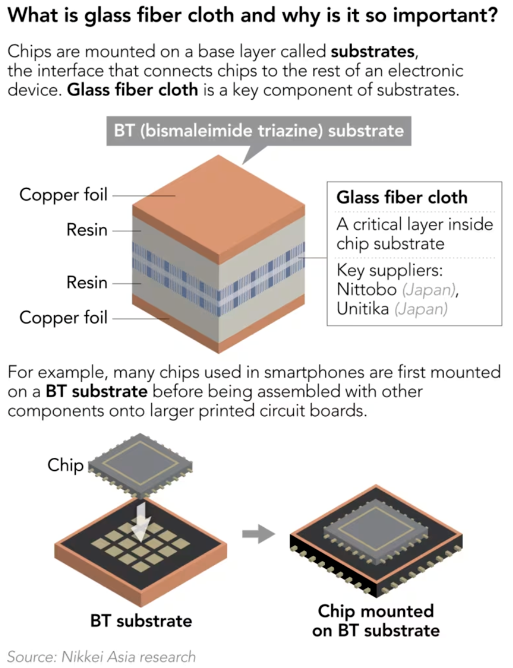
Many new entrants hope to profit from the supply constraints, such as Taipei-based traditional glass manufacturer Taiwan Glass, and Chinese companies like Taishan Fiberglass, Grace Fabrics, and Jinbo Laminates Group.
However, sources familiar with the matter say the technological barriers to entry in this field are extremely high—each fiber is much thinner than a human hair and must be perfectly rounded and free of any air bubbles—making it difficult for new entrants to achieve sufficient production capacity and consistent quality. Industry executives told Nikkei Asia that no tech giant is willing to risk mounting high-end chips on substrates that could affect the quality of the final product.
A source at a substrate equipment manufacturer said, "The stability of the T-fiber cloth is a decisive factor in substrate quality." A PCB manufacturing executive stated that because the T-fiber cloth is located deep within the device substrate, it cannot be removed and repaired.
Apple was the first to use high-end fiberglass in its smartphones, long before leading companies in the AI chip field began using this material on a large scale in their products. But even Apple, with its strong purchasing power, could not have anticipated that industry giants like Nvidia, Amazon, and Google would join the competition.
Apple, headquartered in Cupertino, California, has discussed using lower-tech fiberglass cloth with its suppliers, but according to two people familiar with the matter, testing and validating the alternative material will take time and therefore will not help improve the situation immediately.
AI-driven investment
T-glass isn't the only pain point in the technology supply chain.
As previously reported by Nikkei Asia, AI-driven investments have already thrown the memory chip market into turmoil, with consumer electronics, PC, and smartphone manufacturers scrambling to secure supplies of critical DRAM and NAND flash memory components needed until 2026. Market research firm Counterpoint predicts that memory chip shortages will lead to a decline in the smartphone market in 2026.
Chiefs in the chip and electronics industries say that many other components and materials related to chip substrates and printed circuit boards may also face shortages this year.
Several industry insiders cited the example of drill bits and drilling machines used to drill holes in server printed circuit boards. In the past, a drill bit could be reused multiple times, but AI server circuit boards are becoming thicker, harder, and more expensive, meaning that drill bits must be more advanced and replaced more frequently.
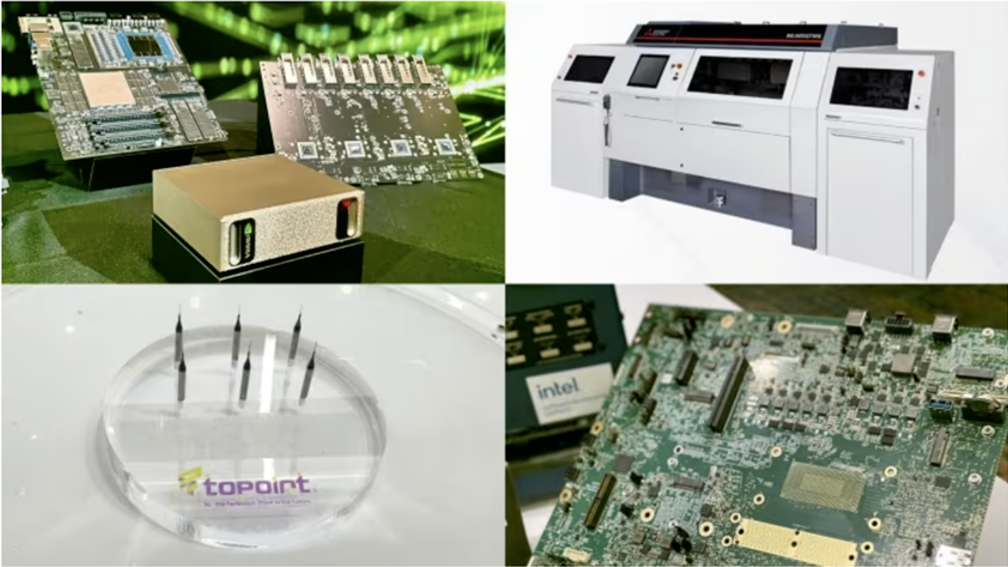
A source stated that Guangdong Ditai Technology Co., Ltd., Shenzhen Jinzhou Precision Technology Co., Ltd., and Taiwan Top Technology Co., Ltd. are the largest drill bit suppliers in terms of production capacity, but smaller companies like United Tools and Kyocera in Japan offer the highest product quality.
Japanese suppliers often occupy key positions in the supply chain, and their reluctance to expand as rapidly as the overall AI market is one reason why bottlenecks in one component can quickly become problems for the rest of the supply chain.
For example, Taiyo Ink dominates the solder resist market, a coating used on all printed circuit boards to prevent short circuits, reduce production yields, and improve reliability. According to Nikkei Asia, laser drilling machines from Mitsubishi Electric and Via Machinery are almost the only option for companies requiring advanced laser drilling capabilities.
A source stated, "Due to the sudden cross-industry downturn at the end of 2022 leading to oversupply, many suppliers are now reluctant to expand capacity, fearing another round of overbooking." The supply chain disruptions during the COVID-19 pandemic led to rapid capacity expansion, and the aftereffects of this expansion have followed the decline in demand for PCs and other devices.
Nittobo recently told Nikkei Asia that it will continue to prioritize quality over quantity and will not become a manufacturer of commoditized components.
"Losing some market share is inevitable," said Nittobo CEO Hiroyuki Tada. He acknowledged pressure to expand capacity but also pointed out that the risks a small supplier like his can take are limited.
"We do see some tech companies eager to try alternatives and validate other suppliers; for example, some are even exploring different types of glass cloth, but progress won't be quick because quality remains the primary consideration," said Chiu Shih-fang, a technology supply chain analyst at the Taiwan Institute of Economic Research.
Mr. Qiu stated, "Consumer electronics manufacturers may face even greater pressure because the production capacity of fiberglass cloth used to manufacture these products is already limited, and now they also have to compete with the purchasing power of large AI companies like Nvidia. This situation is similar to the memory market, where suppliers tend to prioritize the needs of AI-related tech giants rather than price-sensitive consumer electronics manufacturers. If even a powerful company like Apple is feeling the pressure of production capacity constraints, then smaller manufacturers may face an even more severe situation."
Chris Lin, Chairman and President of Aspeed Technology, a leading global developer of server motherboard management controller chips, stated that limitations on chip substrates and other supply chain bottlenecks are hindering the potential for AI demand in 2026.
Lin stated, "We do see very strong demand and good growth momentum in 2026, but due to limited raw material supplies, we have had to lower our forecasts."
Source: Compiled from chosun