Samsung has shown its HBM4 memory modules to the public for the first time, showing that the South Korean giant is indeed ready for the upcoming HBM competition.
While the market is currently dominated by fifth-generation HBM3E chips, industry observers expect HBM4 to become a major factor next year as Nvidia plans to use it in its next-generation AI accelerator, Rubin.
SK Hynix, currently the primary supplier of HBM3E, forms a three-way supply chain with Nvidia and TSMC. The company has completed HBM4 development and is preparing for mass production. The company is reportedly in talks with Nvidia for large-scale supply.
For Samsung Electronics, which has long dominated the memory market but recently lost ground in the HBM sector, the new HBM4 series is seen as a potential game-changer for regaining its competitive advantage.
At its shareholders' meeting in March, Jeon Young-hyun, head of Samsung Electronics' semiconductor division, vowed to proceed with the development and mass production of HBM4 products as planned to avoid a repeat of the company's previous failures in the HBM3E market.
According to a recent report from Counterpoint Research, SK Hynix led HBM shipments in the second quarter, holding a 62% share, followed by Micron Technology (21%) and Samsung Electronics (17%).
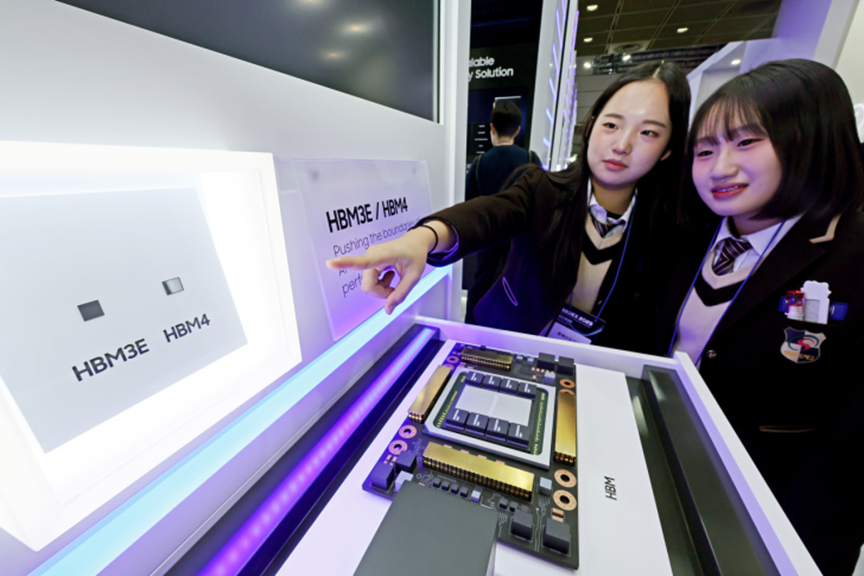
HBM4 is one of the most prestigious computing essentials in the market today, primarily due to its role in boosting AI performance. Korean HBM manufacturers such as Samsung, SK Hynix, and Micron are working tirelessly to showcase competitive HBM4 solutions globally to secure adoption. Among major HBM manufacturers, Samsung is one of the companies making a strong comeback in the field after years of sluggish performance. At the Semiconductor Expo 2025 (SEDEX), Samsung showcased its HBM4 process.
Samsung is reportedly trying to avoid repeating its past mistakes and losing its dominant position in the DRAM market. To ensure it stays ahead, the South Korean giant is working alongside its competitors to advance HBM4 mass production. According to DigiTimes, Samsung's HBM4 logic chip yield has reached an astonishing 90%, indicating that the company's mass production schedule is on track and, more importantly, no delays are currently expected.
The South Korean giant is also reportedly implementing several strategies to ensure early adoption of HBM4, including maintaining competitive pricing, providing increased production capacity, and, importantly, offering customers like NVIDIA faster pin speeds (rated at approximately 11 Gbps), exceeding the expected speeds of SK Hynix and Micron. Samsung has not yet received approval from NVIDIA to supply HBM4, but given the technology's progress, the South Korean giant is undoubtedly optimistic.
In addition to Samsung, SK Hynix also showcased its HBM4 module, developed in collaboration with TSMC, at the show. Considering Samsung's rapid growth and the unprecedented market demand, it's certain that competition in the DRAM market will intensify in the future.
The Big Three, competing for HBM 4
SK Hynix, Micron Technology, and Samsung Electronics are locked in a fierce competition for dominance in the HBM4 market, estimated to be worth $100 billion (KRW 141 trillion).
Following SK Hynix's completion of next-generation HBM4 development and establishment of mass production systems last month, Samsung Electronics has also begun preparations for HBM4 mass production. Meanwhile, Micron recently announced that it has begun shipping samples of its next-generation HBM4 memory, boasting record-breaking performance and efficiency.
Micron CEO Sanjay Mehrotra stated, "The module achieves bandwidth exceeding 2.8TB/s and pin speeds exceeding 11Gbps." These figures significantly exceed the official JEDEC HBM4 specifications of 2TB/s and 8Gbps.
Micron Technology has begun shipping 12-Hi HBM4 samples to support major customer platform upgrades, claiming the product offers industry-leading performance and best-in-class energy efficiency. The company added that key differentiators of its 12-Hi HBM4 products include Micron's 1-gamma DRAM and proprietary CMOS-based die and packaging innovations.
Regarding HBM4E, which extends the base design with custom logic chip options, Micron announced that it will offer not only standard products but also custom base logic chip options.
CEO Sanjay Mehrotra stated, "Customization requires close collaboration with customers, and we expect HBM4E with custom base logic chips to deliver higher gross margins than standard HBM4E." He added, "This technology, developed in collaboration with TSMC, enables key customers such as NVIDIA and AMD to custom-design accelerators with optimized memory stacks for low latency and better packet routing."
Micron plans to capture a significantly higher share of the $100 billion HBM market this year than last year and expects revenue from high-bandwidth memory to exceed $8 billion this year.
SK Hynix, a leading company in the HBM field, announced that it shipped 12-Hi HBM4 samples to major customers such as NVIDIA in March, ahead of Micron, Samsung, and others, and will begin preparations for mass production in September.
SK Hynix's 12-Hi HBM4 product, manufactured using TSMC's 12nm process for the logic chip, acts as the "brain," and is said to process data at speeds exceeding 2TB (terabytes) per second. However, it's unclear whether this product surpasses Micron's 12-Hi HBM4 product, which boasts a bandwidth exceeding 2.8TB/s.
SK Hynix also plans to offer customized HBM4E products within its HBM4E series to meet the needs of customers such as NVIDIA, Broadcom, and AMD.
Samsung Electronics reportedly shipped HBM4 samples to customers such as NVIDIA in September, operating at speeds up to 11Gbps, matching Micron's specifications. Samsung is also preparing for HBM4 mass production, aiming to begin this year.
Source: Content compiled from wcctech